Fix Lawyer PPC Leads
Lawyer PPC: Fix High Calls No Retainers
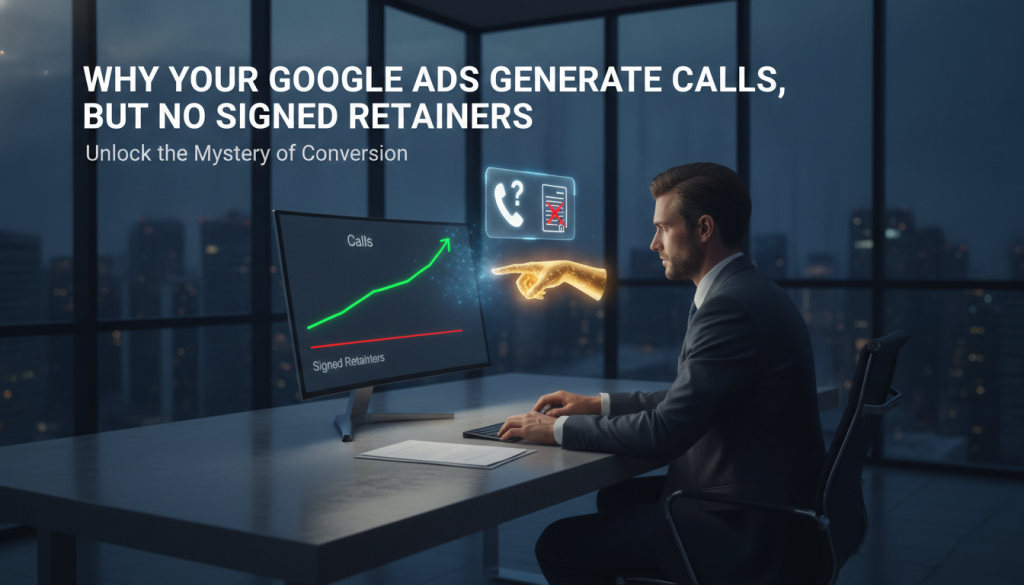
Featured Snippet Answer: Google Ads generate calls but no signed retainers primarily due to poor keyword intent, broad match keyword settings, and a disconnect between ad copy and landing page messaging. For law firms, bidding on informational queries rather than high-intent transactional keywords attracts free-seekers instead of qualified clients ready to hire an attorney.
Investing in PPC for lawyers can be one of the most lucrative marketing decisions a law firm makes, but it can also become a massive financial drain if not executed with precision. Many attorneys experience the frustrating phenomenon where their Google Ads dashboard shows excellent metrics—high click-through rates, low cost-per-click, and dozens of phone calls—yet their actual signed caseload remains stagnant. This disconnect between marketing metrics and bottom-line revenue often leads firms to falsely conclude that paid search simply does not work for their specific practice area.
The reality is far more nuanced. When the phone is ringing but retainers are not being signed, the issue rarely lies with the Google Ads platform itself. Instead, the problem stems from lead quality, user intent, and the friction present within the firm’s intake process. Generating a phone call is only the first micro-conversion in a complex client acquisition journey. If the person on the other end of the line is seeking free legal advice, looking for a pro bono attorney, or researching a completely different legal issue, the ad spend has been entirely wasted.
Understanding the root causes of this discrepancy requires a deep dive into campaign architecture, targeting parameters, and the psychological state of the searcher. By systematically identifying where the breakdown occurs—whether in keyword selection, negative keyword lists, ad messaging, or the intake team’s handling of the call—law firms can pivot their strategy from generating mere noise to acquiring high-value, paying clients who are ready to sign a retainer agreement.
Why Do My Legal Google Ads Drive Junk Calls?
Answer Block: Legal Google Ads drive junk calls when campaigns lack robust negative keyword lists, rely too heavily on broad match types, and fail to qualify users through specific ad copy. This combination allows Google’s algorithm to serve ads to users seeking free advice rather than paid legal representation.
One of the primary culprits behind an influx of low-quality phone calls is the misuse of keyword match types within the Google Ads ecosystem. When attorneys launch campaigns utilizing broad match keywords without extensive negative keyword lists, they essentially give Google’s machine learning algorithms permission to interpret their target phrases loosely. For example, a broad match keyword like “divorce lawyer” might trigger ads for search queries such as “how to file for divorce for free” or “pro bono divorce attorney near me.” These searchers have high urgency but zero budget, leading to phone calls that consume your intake team’s time but never result in a signed retainer.
Another significant factor contributing to junk calls is the failure to properly utilize negative keywords to filter out unqualified traffic. A negative keyword list acts as a protective shield for your advertising budget. In the context of PPC for lawyers, failing to negate terms like “free,” “cheap,” “legal aid,” “pro bono,” “DIY,” and “template” guarantees that a portion of your ad spend will be wasted on individuals who have no intention—or financial capacity—to hire a private law firm. Continuous search terms report auditing is non-negotiable for maintaining high lead quality.
Furthermore, the actual messaging within your ad copy plays a critical role in pre-qualifying the individuals who choose to call your firm. If your ad copy is overly generic or promises immediate, cost-free solutions, you will naturally attract a demographic looking for quick answers rather than professional representation. Ad copy must strike a delicate balance between being compelling enough to earn the click from a qualified prospect and specific enough to deter those who are not a good fit for your services.
- Broad Match Pitfalls: Relying on broad match without supervision invites irrelevant search queries that drain daily budgets.
- Missing Negative Keywords: Failing to exclude terms like “pro bono” or “free consultation” (if you charge for them) attracts non-buyers.
- Misaligned Ad Copy: Using clickbait headlines that do not accurately reflect the premium nature of your legal services.
- Poor Location Targeting: Serving ads to users outside your jurisdiction who cannot legally hire you.
- Network Settings: Leaving the Google Search Partners or Display Network enabled for direct-response search campaigns.
How Does Keyword Intent Impact Retainer Signings?
Answer Block: Keyword intent dictates the searcher’s readiness to hire an attorney. Informational intent brings users seeking answers, while transactional intent brings users ready to sign a retainer. Bidding on low-intent keywords generates high call volumes from people who are merely researching, resulting in zero signed contracts.
Understanding the spectrum of search intent is arguably the most critical component of running successful PPC for lawyers. Search intent refers to the underlying goal or purpose behind a user’s query on Google. In the legal sector, intent can generally be categorized into informational, navigational, and transactional phases. When a law firm’s Google Ads account is heavily weighted toward informational intent keywords—such as “what is the penalty for a first time DUI”—the firm will inevitably receive a high volume of calls from individuals who are simply panicked and looking for free legal information, rather than someone ready to pay for defense counsel.
Conversely, transactional intent keywords indicate that the searcher has moved past the research phase and is actively seeking to hire an attorney. Queries like “DUI defense lawyer near me,” “hire criminal attorney,” or “best personal injury lawyer in [City]” carry a significantly higher likelihood of converting into a signed retainer. While these transactional keywords typically come with a much higher cost-per-click (CPC) due to increased competition among local law firms, the return on investment is vastly superior because the conversion rate from phone call to paying client is exponentially higher.
The disconnect between calls and retainers often happens when firms try to outsmart the high CPCs of transactional keywords by bidding on cheaper, informational terms. They assume their intake team can “sell” the caller on hiring the firm. However, this strategy rarely works in practice. A caller seeking a definition of a legal term is psychologically entirely different from a caller looking to book an immediate strategy session. Aligning your keyword strategy exclusively with high-intent searchers is the most direct path to improving your retainer signing rate.
| Keyword Type | Searcher Intent | Example Query | Call Quality | Retainer Potential |
|---|---|---|---|---|
| Informational | Seeking free advice or answers | “How long does a divorce take?” | Low (Time-wasters) | Very Low |
| Navigational | Looking for a specific firm/entity | “Smith and Jones Law Office” | Variable | High (If it’s your firm) |
| Transactional | Ready to hire representation | “Hire child custody lawyer” | High (Qualified leads) | Very High |
| Comparative | Weighing different attorneys | “Best defense attorney reviews” | Medium to High | High |
What Are The Steps To Optimize PPC For Lawyers?
Answer Block: Optimizing legal PPC requires a systematic approach: auditing search term reports, refining match types, implementing aggressive negative keywords, aligning landing pages with ad copy, and tracking offline conversions. This step-by-step process ensures that ad spend is exclusively directed toward high-intent users capable of signing retainers.
The first and most crucial step in optimizing any legal Google Ads campaign is to conduct a ruthless audit of the Search Terms Report. Unlike the keywords you actively bid on, the search terms report shows the exact phrases users typed into Google before clicking your ad. By reviewing this data, attorneys can immediately identify the specific queries driving junk calls. If you notice a trend of irrelevant questions or out-of-jurisdiction searches, you must act quickly to add these terms to your negative keyword lists, preventing future budget waste.
Following the search terms audit, the next phase of optimization involves restructuring your keyword match types and segmenting your ad groups by specific legal services. Single-theme ad groups allow for highly relevant ad copy that speaks directly to the user’s specific legal issue. For instance, a family law firm should not mix “child support” keywords with “alimony” keywords in the same ad group. By separating them, you can craft specific ad headlines and direct users to dedicated landing pages, which significantly increases the conversion rate from a click to a highly qualified, retainer-ready phone call.
Finally, implementing offline conversion tracking is a game-changer for law firms struggling with lead quality. Standard Google Ads tracking only tells the algorithm that a phone call occurred, treating all calls equally. By importing offline conversion data—such as which specific clicks resulted in a signed retainer in your CRM—you train Google’s automated bidding strategies (like Target CPA or Maximize Conversions) to optimize for actual paying clients rather than just raw call volume. This feedback loop is essential for long-term campaign profitability.
- Audit the Search Terms Report: Review the exact queries triggering your ads weekly to identify and eliminate wasted spend.
- Build a Robust Negative Keyword List: Proactively block terms associated with free services, DIY legal templates, and irrelevant practice areas.
- Transition to Exact and Phrase Match: Move away from broad match to maintain tighter control over which searches trigger your legal ads.
- Create Dedicated Landing Pages: Ensure the user’s post-click experience exactly matches the promise made in the ad copy, increasing trust and conversion rates.
- Implement CRM Integration: Feed signed retainer data back into Google Ads to train the algorithm on what a successful conversion actually looks like.
- Optimize Intake Protocols: Train your reception or intake team to properly qualify leads, handle objections, and seamlessly transition high-quality calls into signed contracts.
What Are Common Mistakes In Law Firm Lead Generation?
Answer Block: Common mistakes in law firm lead generation include sending paid traffic to generic homepage URLs, failing to track call outcomes, ignoring the intake team’s performance, and utilizing automated bidding strategies without proper conversion data. These errors inflate call volumes while suppressing actual client acquisition rates.
One of the most pervasive mistakes law firms make in their PPC campaigns is routing expensive, high-intent paid traffic directly to their website’s homepage. A homepage is designed to act as a digital brochure, offering a broad overview of the firm’s history, various practice areas, and general contact information. When a user searching for an “emergency criminal defense attorney” clicks an ad and lands on a generic homepage, they are forced to hunt for the specific information they need. This friction causes high bounce rates and results in calls from confused users, rather than streamlined conversions from dedicated, service-specific landing pages.
Another critical error is treating the intake process as an afterthought. Law firms often spend thousands of dollars optimizing their Google Ads, only to have the resulting phone calls answered by an untrained receptionist, an automated phone tree, or an external answering service that lacks legal context. If the intake team is not equipped with a structured script to qualify leads, empathize with the caller’s situation, and swiftly schedule a consultation, even the highest-quality PPC leads will fail to convert into signed retainers. The marketing campaign is frequently blamed for poor lead quality when the actual failure occurred during the phone handling process.
Lastly, trusting Google’s automated bidding algorithms blindly without providing accurate conversion data is a recipe for high-volume, low-quality leads. Algorithms like “Maximize Conversions” are designed to get you the most conversions possible within your budget. If your campaign defines a “conversion” simply as any phone call lasting longer than 30 seconds, the algorithm will aggressively seek out users who are likely to call, regardless of their intent to hire. Without feeding actual signed retainer data back into the system, the AI has no way of distinguishing between a lucrative personal injury case and someone asking for directions to the courthouse.
- Homepage Routing: Sending specific legal queries to a broad homepage instead of a highly relevant, conversion-optimized landing page.
- Intake Mishandling: Allowing calls to go to voicemail or failing to train intake staff on how to convert inquiries into consultations.
- Ignoring Ad Scheduling: Running ads 24/7 when the firm cannot answer the phone, leading to missed opportunities and wasted budget.
- Flawed Conversion Definitions: Telling Google that every phone call is a success, which trains the algorithm to prioritize volume over lead quality.
- Neglecting Mobile Optimization: Failing to ensure that landing pages load instantly and feature prominent click-to-call buttons for mobile users.
Comprehensive FAQ: Troubleshooting Legal PPC
Answer Block: This comprehensive FAQ addresses the most pressing concerns law firms have regarding their PPC campaigns. From understanding cost-per-click dynamics to improving intake procedures, these answers provide actionable insights to bridge the gap between generating phone calls and securing signed legal retainers.
Navigating the complexities of paid search for legal services requires a deep understanding of both the advertising platform and the psychology of the prospective client. Many attorneys find themselves asking the same questions when their campaigns fail to yield the desired financial results. By addressing these common queries, firms can better diagnose their specific campaign bottlenecks.
The following frequently asked questions are compiled from real-world scenarios experienced by law firms attempting to scale their client acquisition through Google Ads. Each answer is designed to provide clarity on technical campaign settings, strategic keyword selection, and the critical operational processes required to close high-value leads.
Whether you are managing your campaigns in-house or working with an external digital marketing agency, understanding these core concepts will empower you to make data-driven decisions. Review these FAQs to identify potential gaps in your current strategy and implement the necessary corrections to turn your ad spend into profitable legal retainers.
Why am I getting calls from people looking for free legal advice?
You are likely bidding on informational keywords or using broad match types without a sufficient negative keyword list. Users searching for “how to…” or “can I…” are usually in the research phase. To fix this, add terms like “free,” “pro bono,” and “legal aid” to your negative keyword list, and focus your bids on transactional keywords like “hire [practice area] lawyer.”
How much should a law firm spend on Google Ads?
The ideal budget depends entirely on your jurisdiction, practice area, and growth goals. Highly competitive areas like personal injury in major cities may require tens of thousands of dollars monthly just to compete, whereas a niche practice in a smaller market might succeed with a few thousand. The key is ensuring your budget is large enough to sustain enough clicks to generate statistically significant conversion data.
Are Local Services Ads (LSAs) better than standard Search Ads?
LSAs and standard Search Ads serve different purposes and should ideally be used together. LSAs appear at the top of the page, build immediate trust through the “Google Screened” badge, and charge per lead rather than per click. However, standard Search Ads offer far more control over targeting, keyword selection, and ad messaging, making them essential for targeting specific, high-value case types.
How do I track which calls turn into signed retainers?
You must implement a CRM (Customer Relationship Management) system that integrates with Google Ads. By using dynamic number insertion (DNI) through tools like CallRail, you can tie a specific phone call back to the exact keyword and ad click. When that caller signs a retainer, the CRM sends a signal back to Google Ads, recording it as an offline conversion.
Why is my cost-per-click (CPC) so high?
Legal keywords are among the most expensive on Google because the lifetime value of a signed client is exceptionally high. High CPCs are driven by intense competition. To mitigate this, focus on improving your Quality Score by ensuring your ad copy and landing pages are highly relevant to your target keywords, which can lower your actual CPC over time.
Should I bid on my competitors’ brand names?
Bidding on competitor names can be a viable strategy to capture comparative shoppers, but it often yields lower conversion rates and higher costs due to poor Quality Scores (since your landing page won’t match their brand name). It is generally better to max out your budget on high-intent, non-branded transactional keywords before experimenting with competitor conquesting.
How quickly should my intake team respond to a PPC lead?
Immediately. The legal consumer is often in a state of distress or urgency. If your intake team does not answer the call live, or if a form fill is not responded to within five minutes, the prospect will simply click the next ad on Google. Speed to lead is a critical factor in converting PPC calls into retainers.
Does landing page design actually affect my retainer rate?
Absolutely. A landing page must instantly convey trust, authority, and relevance. If a user clicks an ad for “motorcycle accident attorney” and lands on a page about general personal injury with no mention of motorcycles, they will bounce. High-converting landing pages feature clear headlines, strong calls-to-action, trust badges, and social proof to persuade the caller to hire you.
Can I run Google Ads for my law firm myself?
While it is possible to run campaigns independently, PPC for lawyers is highly competitive and technically complex. Without a deep understanding of match types, bidding strategies, and conversion tracking, you risk wasting significant amounts of money. Most successful law firms eventually partner with specialized legal marketing agencies to maximize their return on ad spend.
What is the difference between a lead and a qualified lead?
A lead is simply anyone who contacts your firm—this includes solicitors, out-of-state callers, and people seeking free advice. A qualified lead is an individual who has a legitimate legal issue within your practice area, is located in your jurisdiction, and possesses the financial means to pay your retainer fee. Your Google Ads strategy should be optimized exclusively for the latter.
Asset & Interlinking Strategy Guidelines
Answer Block: A robust asset and interlinking strategy enhances the SEO value of your legal marketing content. By strategically connecting internal resources and optimizing image metadata with entity-rich alt text, law firms can improve their site architecture, establish topical authority, and provide a superior user experience for prospective clients.
Effective internal linking is a cornerstone of advanced search engine optimization. When structuring content around PPC for lawyers, it is essential to guide the reader toward related topics that deepen their understanding of legal marketing. Internal links distribute page authority throughout your domain and help search engines understand the semantic relationships between different pieces of content. For a law firm’s marketing blog, linking to detailed guides on intake processes, landing page optimization, and CRM integration creates a comprehensive web of authoritative information.
When selecting anchor text for these internal links, avoid generic phrases like “click here” or “read more.” Instead, utilize descriptive, keyword-rich anchor text that accurately reflects the destination page’s topic. This practice not only aids search engine crawlers but also sets clear expectations for the user. A well-executed interlinking strategy keeps potential clients engaged on your website longer, reducing bounce rates and increasing the likelihood that they will eventually reach out for a consultation.
Furthermore, visual assets play a crucial role in modern SEO, particularly with the rise of visual search technologies like Google Lens. Every image embedded within your content must be optimized with descriptive alt text. Alt text should not merely stuff keywords; it must accurately describe the image while naturally incorporating relevant entities and semantic terms. This ensures that your content is accessible to all users and provides additional context to search engines regarding the subject matter of your page.
- Internal Link Suggestion 1: Anchor text: legal landing page optimization – Link to a guide on designing high-converting landing pages for law firms.
- Internal Link Suggestion 2: Anchor text: law firm intake process – Link to an article detailing how receptionists should handle inbound PPC calls.
- Internal Link Suggestion 3: Anchor text: offline conversion tracking for attorneys – Link to a technical tutorial on connecting legal CRMs to Google Ads.
- Internal Link Suggestion 4: Anchor text: negative keywords for legal PPC – Link to a comprehensive list of terms law firms should exclude from their campaigns.
- Image Alt Text 1: “Lawyer reviewing Google Ads search terms report on a dual-monitor setup to identify negative keywords.”
- Image Alt Text 2: “Comparison chart showing informational versus transactional keyword intent for law firm marketing.”
- Image Alt Text 3: “Attorney shaking hands with a client after signing a legal retainer agreement in a modern boardroom.”
- Image Alt Text 4: “Law firm intake specialist answering a high-quality PPC phone call using a headset and CRM software.”
- Image Alt Text 5: “Mobile phone displaying a highly optimized legal landing page with a prominent click-to-call button.”
Action Point:
Ready to transform your law firm’s lead quality? Contact us at {{website}} today to audit your legal PPC campaigns and start signing high-value retainers.